Virtual Reality (VR) in Palliative Care: Distraction Therapy for Pain
Pain is one of the most distressing symptoms experienced by patients in palliative care, often affecting physical comfort, emotional well-being, and overall quality of life. While pharmacological treatments remain the cornerstone of pain management, there is growing interest in non-pharmacological approaches that can complement traditional therapies and reduce reliance on medications.
One such innovative approach is Virtual Reality (VR), which uses immersive digital environments to engage patients’ senses and shift their attention away from pain. By creating a sense of presence in a different, often calming or enjoyable environment, VR acts as a powerful distraction therapy, helping to reduce the perception of pain and anxiety.
In palliative care settings, where the focus is on comfort and quality of life, VR offers a unique opportunity to provide psychological relief, emotional comfort, and meaningful experiences. Whether it is virtually visiting a beach, revisiting familiar places, or engaging in relaxing activities, VR can help patients momentarily escape the burden of illness and experience a sense of peace and control.
What is Virtual Reality in Healthcare?
Virtual Reality (VR) refers to the use of computer-generated, immersive environments that patients can interact with using head-mounted displays or similar devices. In healthcare, VR is increasingly being used for:
- Pain management
- Anxiety reduction
- Rehabilitation
- Psychological therapy
In palliative care, its role is primarily supportive and comfort-focused, aiming to enhance patient experience rather than treat the disease itself.
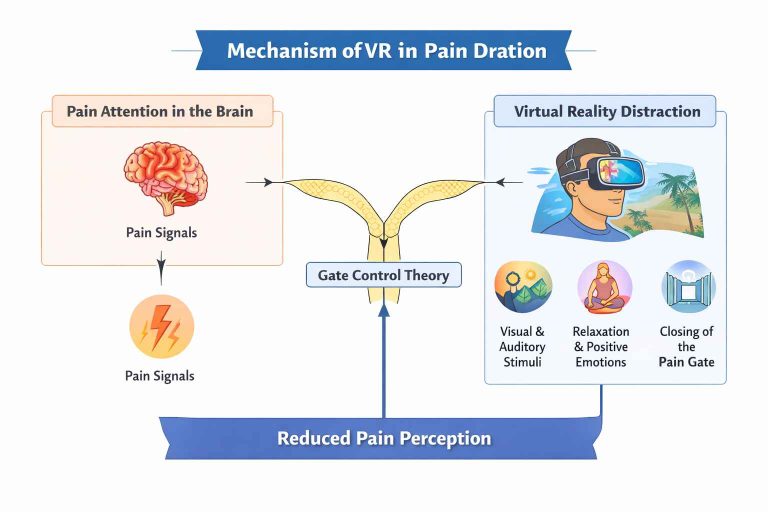
Mechanism of VR in Pain Distraction
Virtual Reality (VR) reduces pain primarily through the principle of distraction and attentional modulation. Pain perception is not only a physical sensation but also influenced by how much attention the brain gives to it. VR creates an immersive, multi-sensory environment that captures the patient’s attention, thereby diverting focus away from pain signals.
By engaging visual, auditory, and sometimes interactive elements, VR reduces the brain’s capacity to process pain, a concept explained by the Gate Control Theory of Pain. According to this theory, non-painful stimuli can “close the gate” to painful input, reducing the perception of pain.Additionally, VR can:
- Reduce anxiety and stress, which are known to amplify pain perception
- Promote relaxation and emotional comfort
- Provide a sense of escape and control, especially in terminal illness
- Stimulate positive emotions, which can alter pain experience
Applications of Virtual Reality in Palliative Care
Virtual Reality (VR) is increasingly being used in palliative care as a supportive, non-pharmacological intervention to improve patient comfort and overall well-being. Its applications extend beyond pain relief to address multiple physical and psychological symptoms.
- Pain Management
- Acts as a distraction therapy to reduce perception of pain
- Useful during procedures (e.g., dressing changes, injections)
- Can complement analgesics and reduce reliance on medications
- Anxiety and Stress Reduction
- Immersive environments (nature, music, guided relaxation) help reduce anxiety
- Provides a calming effect in patients facing serious illness
- Emotional and Psychological Support
- Helps manage depression, fear, and distress
- Provides a sense of escape from illness and hospital environment
- Enhancing Quality of Life
- Allows patients to experience places or activities they can no longer physically access
- Promotes joy, relaxation, and meaningful engagement
Advantages
- Effective pain distraction – reduces perception of pain without additional medications
- Non-invasive and safe – minimal physical risk
- Reduces anxiety and distress – calming immersive environments
- Enhances quality of life – provides enjoyable and meaningful experiences
- Easy to use – portable devices, can be used at bedside or home
- Reduces medication burden – may decrease need for high-dose analgesics
- Improves patient satisfaction – engaging and personalized therapy
Limitations
- Cost and availability – VR devices may not be accessible in all settings
- Technical challenges – requires setup and basic training
- Not suitable for all patients:
- Severe cognitive impairment
- Motion sickness (cybersickness)
- Limited duration of effect – benefit may be temporary
- Lack of widespread evidence in palliative care (still emerging field)
- Physical limitations – patients with severe weakness may not tolerate headsets