The Rehab Doc Offical

TOI Style Scroll Menu

Meditation and Mindfulness: Tools for the Patient and the Clinician

Introduction

Patients living with serious illness often face a constant interplay of pain, uncertainty, fear, and emotional distress. At the same time, clinicians working in palliative care encounter high emotional demands, burnout, and compassion fatigue. In this shared space of suffering, meditation and mindfulness offer simple yet powerful tools to improve well-being for both patients and healthcare providers.

Mindfulness refers to the practice of paying attention to the present moment, intentionally and without judgment, while meditation is a structured technique used to cultivate this awareness. Together, they help individuals develop calmness, acceptance, and resilience, making them highly relevant in palliative care settings.

What is Mindfulness and Meditation?

Mindfulness

Mindfulness is the practice of being fully aware of the present moment, including one’s thoughts, emotions, bodily sensations, and surroundings—without judgment or reaction.

Instead of worrying about the future or dwelling on the past, mindfulness helps individuals anchor their attention in the “here and now.”

Example: A patient noticing their breathing, the sensation of their body resting, or the sounds around them—without labeling them as “good” or “bad.”

Meditation

Meditation is a structured practice used to develop mindfulness and mental calmness. It involves techniques that train attention and awareness.

Common types include:

  • Breathing meditation → focusing on breath
  • Body scan meditation → observing body sensations
  • Guided meditation → listening to instructions
  • Loving-kindness meditation → cultivating compassion

Mechanism of Meditation & Mindfulness

Meditation and mindfulness reduce suffering through interacting neural, autonomic, endocrine, and psychological pathways. The net effect is less reactivity to pain and distress, better emotional regulation, and a sustained relaxation response.

  • Attentional Control & Pain Modulation
    • Mindfulness trains top-down attention (via prefrontal cortex) to shift focus away from nociceptive input.
    • Enhances cognitive reappraisal—patients notice pain without “catastrophizing” it.
    • Engages descending inhibitory pathways (periaqueductal gray, rostral ventromedial medulla) that dampen spinal pain transmission.

    Result: Reduced pain intensity and, more importantly, reduced suffering.

  • Brain Network Changes (Functional Neurobiology)
    • ↑ Prefrontal cortex (PFC) → better executive control and regulation of thoughts
    • ↓ Amygdala activity → reduced fear, threat perception, and anxiety
    • ↓ Default Mode Network (DMN) overactivity → less rumination about past/future
    • ↑ Anterior cingulate cortex (ACC) & insula → improved interoceptive awareness without reactivity

    Result: Calmer, more regulated emotional state and clearer awareness.

  • Autonomic Nervous System (ANS) Balance
    • ↑ Parasympathetic (vagal) tone
    • ↓ Sympathetic arousal (fight–flight)

    Physiologic effects:

    • ↓ Heart rate
    • ↓ Blood pressure
    • ↓ muscle tension
    • More regular breathing

    Result: “Relaxation response” that counteracts stress and pain amplification.

  • Hypothalamic–Pituitary–Adrenal (HPA) Axis Modulation
    • Chronic stress → ↑ cortisol and inflammatory signaling
    • Meditation → downregulates HPA axis, leading to:
      a)↓ Cortisol
      b)Improved circadian rhythm

    Result: Less stress-driven symptom amplification (pain, fatigue, insomnia).

  • Inflammatory & Immune Effects
    • Associated with reduced pro-inflammatory cytokines (e.g., IL-6, TNF-α in some studies)
    • May improve immune regulation in chronic illness

    Result: Lower inflammatory burden contributing to fatigue and malaise.

  • Emotional Regulation & Acceptance
    • Builds non-judgmental awareness → emotions are observed rather than resisted
    • Reduces avoidance and fear of symptoms (e.g., dyspnea, pain spikes)
    • Enhances acceptance and meaning making

    Result: Less anxiety, depression, and existential distress.

  • Cognitive Effects
    • ↓ Rumination (looping negative thoughts)
    • ↑ Cognitive flexibility
    • Improved attention and working memory

    Result: Better coping, clearer thinking, improved communication.
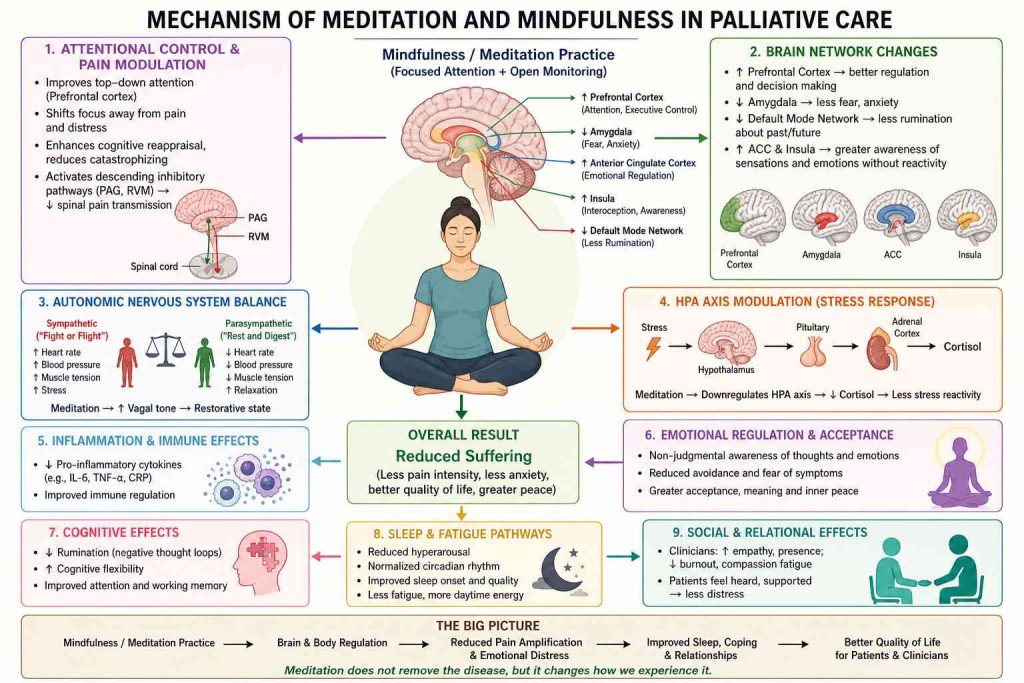
  • Sleep & Fatigue Pathways
    • Reduced hyperarousal + normalized circadian signals → improved sleep onset and quality
    • Better sleep → less fatigue, better daytime function
  • Social & Relational Effects (Clinician–Patient)
    • Clinicians practicing mindfulness show:
      a)↑ Empathy and presence
      b)↓ Burnout and compassion fatigue
    • Patients feel heard and supported, which itself reduces distress.

Real-World Application of Meditation & Mindfulness in Palliative Care

  • At the Bedside (Inpatient Setting)

    When: pain flare, anxiety before a procedure, restlessness at night
    How (2–5 minutes):

    • Sit patient comfortably (or semi-recumbent)
    • Guide: “Focus on your breath… in for 4, out for 6”
    • Add gentle cues: “Notice your shoulders soften… jaw relax”
    • If distracted: “That’s okay—bring attention back to breath”

    Outcome: noticeable calming, reduced distress, easier procedure tolerance

  • During Pain Episodes (Adjunct to Analgesics)

    When: breakthrough pain, waiting for medication to act
    How (3 minutes):

    • Breathing + attention shift: “Place your attention on the breath or a calming image”
    • Optional body scan over the painful area without judgment

    Outcome: lowers pain-related anxiety, often reduces perceived intensity

  • For Sleep Disturbance

    When: difficulty falling asleep, nighttime awakenings
    How (5–10 minutes):

    • Dim lights, reduce noise
    • Slow breathing + guided imagery (beach, temple, nature)
    • Encourage non-striving: “No need to force sleep—just rest with the breath”

    Outcome: improved sleep onset and reduced nocturnal anxiety

  • At End of Life (Emotional Comfort)

    When: fear, existential distress, agitations
    How (brief, gentle):

    • Sit close, calm voice
    • “You are safe… focus on gentle breathing”
    • If appropriate, integrate spiritual or familiar phrases

    Outcome: promotes peace, acceptance, and reduced fear

  • Home-Based Care (Caregiver-Led)

    When: daily routine
    How:

    • Teach caregiver a 2–3 minutes script
    • Use phone audio (guided meditation)
    • Pair with routine (before meals, before sleep)

    Outcome: continuity of care, empowers family, reduces caregiver stress

  • For Clinicians (Micro-Practices During Work)

    When: between patients, after difficult conversations
    How (1–2 minutes):

    • 3 slow breaths before entering room
    • Brief check-in: “What am I feeling?” (no judgment)
    • Reset posture and attention

    Outcome: less burnout, better presence and communication

Dr.Savan Kukadia (MD Palliative Medicine)

I am a physician specialized in Palliative Medicine (MD) with a strong commitment to improving the quality of life for patients with life-limiting illnesses. My clinical focus is on comprehensive symptom management, holistic patient care, and psychosocial support for patients and families.Beyond clinical practice, I am deeply interested in palliative care education, research, and integrating evidence-based practices into patient-centered care. I aim to contribute to the growth of palliative care services, raise awareness about end-of-life issues, and advocate for a more compassionate healthcare system.

Leave a Reply

Your email address will not be published. Required fields are marked *

Scroll to Top