Patients living with serious illness often face a constant interplay of pain, uncertainty, fear, and emotional distress. At the same time, clinicians working in palliative care encounter high emotional demands, burnout, and compassion fatigue. In this shared space of suffering, meditation and mindfulness offer simple yet powerful tools to improve well-being for both patients and healthcare providers.
Mindfulness refers to the practice of paying attention to the present moment, intentionally and without judgment, while meditation is a structured technique used to cultivate this awareness. Together, they help individuals develop calmness, acceptance, and resilience, making them highly relevant in palliative care settings.
What is Mindfulness and Meditation?
Mindfulness
Mindfulness is the practice of being fully aware of the present moment, including one’s thoughts, emotions, bodily sensations, and surroundings—without judgment or reaction.
Instead of worrying about the future or dwelling on the past, mindfulness helps individuals anchor their attention in the “here and now.”
Example: A patient noticing their breathing, the sensation of their body resting, or the sounds around them—without labeling them as “good” or “bad.”
Meditation
Meditation is a structured practice used to develop mindfulness and mental calmness. It involves techniques that train attention and awareness.
Common types include:
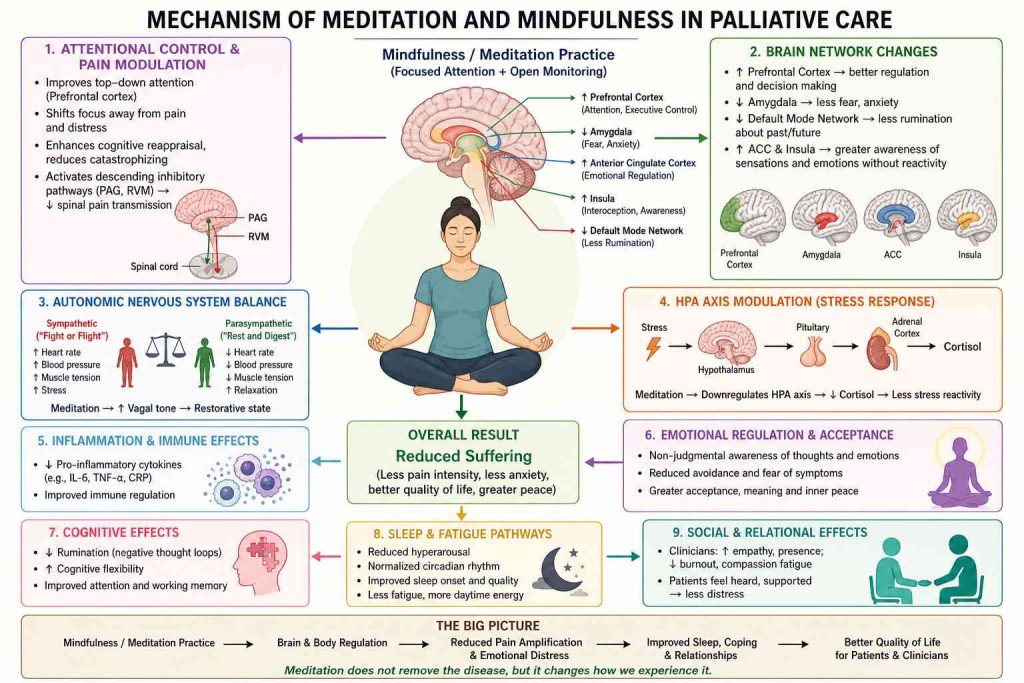
Meditation and mindfulness reduce suffering through interacting neural, autonomic, endocrine, and psychological pathways. The net effect is less reactivity to pain and distress, better emotional regulation, and a sustained relaxation response.
Result: Reduced pain intensity and, more importantly, reduced suffering.
Result: Calmer, more regulated emotional state and clearer awareness.
Physiologic effects:
Result: “Relaxation response” that counteracts stress and pain amplification.
Result: Less stress-driven symptom amplification (pain, fatigue, insomnia).
Result: Lower inflammatory burden contributing to fatigue and malaise.
Result: Less anxiety, depression, and existential distress.
Result: Better coping, clearer thinking, improved communication.
When: pain flare, anxiety before a procedure, restlessness at night
How (2–5 minutes):
Outcome: noticeable calming, reduced distress, easier procedure tolerance
When: breakthrough pain, waiting for medication to act
How (3 minutes):
Outcome: lowers pain-related anxiety, often reduces perceived intensity
When: difficulty falling asleep, nighttime awakenings
How (5–10 minutes):
Outcome: improved sleep onset and reduced nocturnal anxiety
When: fear, existential distress, agitations
How (brief, gentle):
Outcome: promotes peace, acceptance, and reduced fear
When: daily routine
How:
Outcome: continuity of care, empowers family, reduces caregiver stress
When: between patients, after difficult conversations
How (1–2 minutes):
Outcome: less burnout, better presence and communication


I am a physician specialized in Palliative Medicine (MD) with a strong commitment to improving the quality of life for patients with life-limiting illnesses. My clinical focus is on comprehensive symptom management, holistic patient care, and psychosocial support for patients and families.Beyond clinical practice, I am deeply interested in palliative care education, research, and integrating evidence-based practices into patient-centered care. I aim to contribute to the growth of palliative care services, raise awareness about end-of-life issues, and advocate for a more compassionate healthcare system.