The Rehab Doc Offical

TOI Style Scroll Menu

Frailty and Sarcopenia: A Physiatrist's Guide to Screening, Diagnosis and Exercise Prescription

The two conditions every physiatrist should be treating

Ask families why their elderly parent can no longer get out of a chair, and the answer is usually “old age”. Very often, the more precise answer is sarcopenia — and frequently, frailty.

Both conditions are common, measurable and — crucially — treatable. Both respond to the same core intervention: a properly prescribed, progressive exercise programme supported by adequate nutrition. That makes them central to the practice of Physical Medicine & Rehabilitation, yet they remain under-diagnosed in routine clinical care in India.

Definitions: related, but not the same

Sarcopenia is a progressive, generalised skeletal muscle disorder characterised by low muscle strength, low muscle quantity or quality, and — in severe cases — low physical performance. It is now recognised as a disease in its own right, with an ICD-10-CM code (M62.84).

Frailty is a broader clinical state of reduced physiological reserve across multiple systems, leaving the person vulnerable to a sharp decline in health and function after a minor stressor. Two models are widely used:

  • The frailty phenotype(Fried et al., 2001): frail if three or more of — unintentional weight loss, self-reported exhaustion, low grip strength, slow gait speed and low physical activity. One or two criteria indicate pre-frailty.
  • The cumulative deficit model(Rockwood), operationalised clinically as the Clinical Frailty Scale (CFS) — a 9-point judgement-based scale from “very fit” (1) to “terminally ill” (9), with scores of 5 and above generally indicating frailty.

Sarcopenia is a major physical component of frailty, but frailty also includes nutritional, cognitive, psychological and social dimensions.

Why the physiatrist should lead

Frailty and sarcopenia are fundamentally disorders of function and muscle — the physiatrist’s core territory. The PM&R physician is trained to:

  • Measure strength and physical performance objectively.
  • Identify secondary causes of weakness (myopathy, neuropathy, endocrine disease, medication effects).
  • Prescribe exercise with the same precision as a drug: type, intensity, volume, frequency and progression.
  • Coordinate nutrition, physiotherapy and occupational therapy around a functional goal.
  • Use frailty status to plan safe rehabilitation and prehabilitation before surgery.

Screening and diagnosis: using Asian criteria

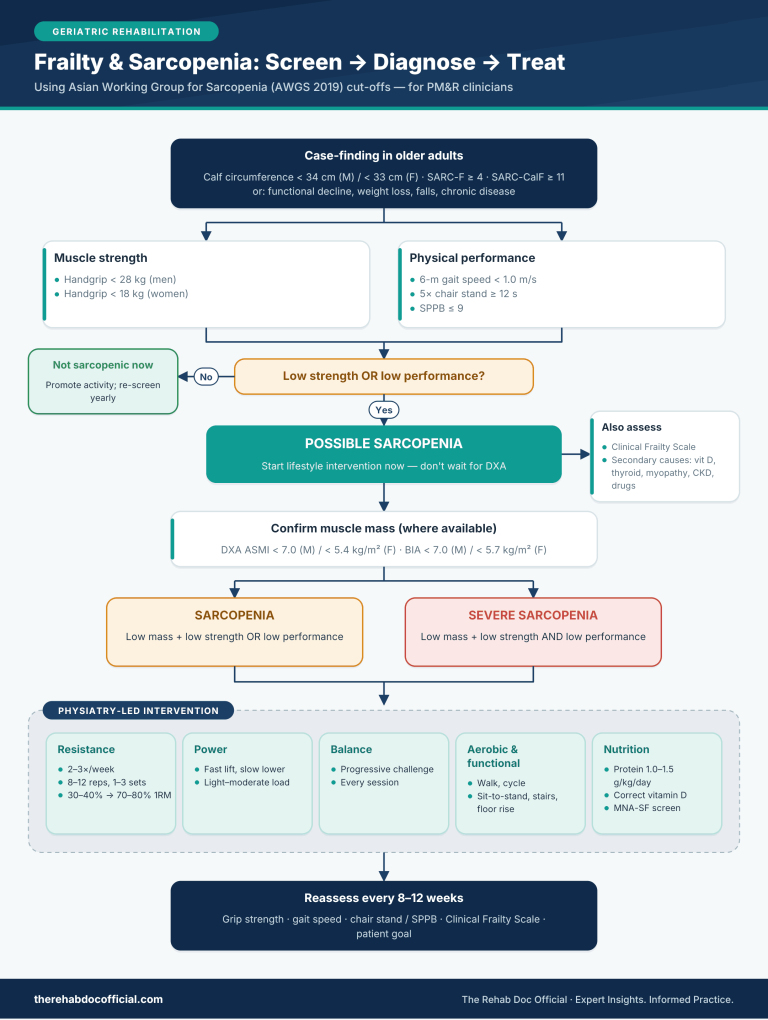
Because body composition and muscle mass differ between populations, Indian clinicians should use the Asian Working Group for Sarcopenia (AWGS) 2019 criteria rather than European or American cut-offs.

Step 1: Case-finding

Screen older adults with any of the following:
  • Calf circumference: < 34 cm in men, < 33 cm in women
  • SARC-F questionnaire score ≥ 4
  • SARC-CalF score ≥ 11
Also screen anyone with a recent functional decline, unintentional weight loss, falls, or chronic conditions such as diabetes, heart failure, COPD or chronic kidney disease.

Step 2: Assess strength and performance

  • Handgrip strength(dynamometer): low if < 28 kg in men, < 18 kg in women
  • Physical performance, any of:
    -> 6-metre usual gait speed < 1.0 m/s
    -> Five-times chair stand test ≥ 12 seconds
    -> Short Physical Performance Battery (SPPB) ≤ 9

In primary care and community settings, AWGS 2019 allows a diagnosis of “possible sarcopenia” on the basis of low grip strength or low performance alone — and recommends starting lifestyle intervention immediately, without waiting for muscle mass measurement.

Step 3: Confirm with muscle mass (where available)

Appendicular skeletal muscle mass index:
  • DXA: < 7.0 kg/m² in men, < 5.4 kg/m² in women
  • Bioimpedance (BIA): < 7.0 kg/m² in men, < 5.7 kg/m² in women
Interpretation:
  • Low muscle mass + low strength orlow performance = sarcopenia
  • Low muscle mass + low strength andlow performance = severe sarcopenia
Muscle ultrasound — a skill many physiatrists already use — is emerging as a useful bedside tool for assessing muscle thickness and quality, though standardised cut-offs are still evolving.

Step 4: Look for secondary causes

Before attributing weakness to age, review for: vitamin D deficiency, hypothyroidism, poorly controlled diabetes, chronic kidney disease, chronic inflammatory disease, malignancy, malnutrition, depression, steroid or statin myopathy, and peripheral neuropathy.

The flowchart below brings screening, diagnosis and intervention together.
Exercise prescription: the core treatment

Exercise is the only intervention with consistent evidence for improving muscle strength, physical performance and frailty status. The International Conference on Frailty and Sarcopenia Research (ICFSR) exercise recommendations (Izquierdo et al., 2021) support a multicomponent programme with resistance training at its core.

1. Progressive resistance training (the priority)

Parameter
Prescription
Frequency
2–3 sessions per week, non-consecutive days
Exercises
6–8 major muscle groups, prioritising leg press or sit-to-stand, knee extension, hip abduction/extension, calf raises, seated row, chest press
Intensity
Begin at about 30–40% of 1-repetition maximum (1RM), progressing towards 70–80% 1RM over weeks
Volume
1–3 sets of 8–12 repetitions
Progression
Increase load when the patient can complete 2 extra repetitions in the final set on two consecutive sessions

Where 1RM testing is impractical, use a rating of perceived exertion: aim for “moderate to somewhat hard” (around 12–14 on the Borg 6–20 scale).

2. Power training

Ageing reduces muscle power faster than strength, and power is closely linked to function — rising from a chair, climbing stairs, recovering from a trip. Once basic strength is established, include exercises performed with a fast concentric (lifting) phase and a slow, controlled lowering phase at light-to-moderate loads.

3. Balance training

Incorporate challenging, progressive balance exercises — narrowing the base of support, tandem stance, single-leg stance, weight shifting and stepping — ideally in every session.

4. Aerobic training

Walking, stationary cycling or arm ergometry, building towards moderate intensity. For very frail patients, aerobic training should follow — not precede — a period of resistance training, as it is the muscle weakness that limits endurance.

5. Functional training

Practise real-life tasks: sit-to-stand, stair climbing, carrying, and getting up from the floor.

Practical considerations

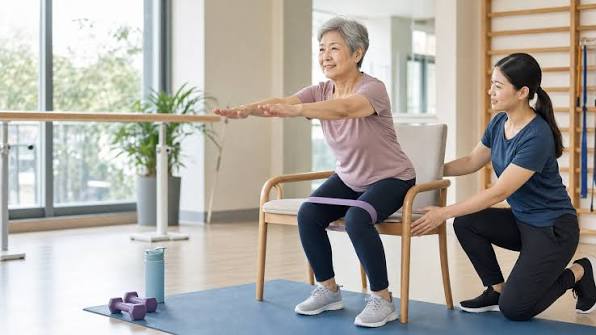
  • Supervision: start with supervised sessions, then transition to a structured home programme with resistance bands, ankle weights or water bottles.
  • Safety: screen for unstable cardiac disease, uncontrolled hypertension and acute illness. Avoid the Valsalva manoeuvre during lifts.
  • Comorbidity adaptation: modify for osteoarthritis (pain-free ranges, low-impact options), osteoporosis (avoid loaded spinal flexion) and cognitive impairment (simple, repetitive routines with caregiver support).
  • Adherence: group classes, family involvement and culturally familiar activities improve long-term participation.

Nutrition: muscle cannot be built from nothing

Exercise without adequate protein and energy will not rebuild muscle in an older adult. Many Indian older adults, particularly those on predominantly vegetarian, cereal-based diets, consume less protein than they need.

  • Protein: the PROT-AGE study group recommends 0–1.2 g/kg/day for healthy older adults and 1.2–1.5 g/kg/day for those with acute or chronic illness (with caution in advanced chronic kidney disease).
  • Distribution: spread protein across meals, rather than concentrating it in one meal.
  • Practical sources: dal, paneer, curd, milk, eggs, soya, sprouts, pulses, fish and lean meat.
  • Vitamin D: correct deficiency, which is common in India despite abundant sunlight.
  • Screening: use the Mini Nutritional Assessment–Short Form (MNA-SF) and involve a dietitian early.

Beyond exercise and nutrition

A complete physiatry-led frailty plan also addresses:

  • Polypharmacy: review and deprescribe where possible.
  • Cognition and mood: depression and cognitive decline both drive inactivity.
  • Fall risk: frailty is a high-risk feature for falls and fractures.
  • Social isolation: loneliness reduces activity and food intake.
  • Prehabilitation: frail patients awaiting elective surgery — joint replacement, spine or cardiac surgery — benefit from a short pre-operative programme of exercise and nutritional optimisation.

Measuring outcomes

Reassess every 8–12 weeks using the same measures used at baseline: grip strength, gait speed, five-times chair stand or SPPB, Clinical Frailty Scale, and a patient-reported functional goal. Showing patients their own improvement is one of the most effective motivators in rehabilitation.

Key takeaways for clinicians

  • Sarcopenia and frailty are common, measurable and treatable— not “just ageing”.
  • Use AWGS 2019 Asian cut-offs: grip < 28 kg (men) / < 18 kg (women); gait speed < 1.0 m/s; chair stand ≥ 12 s; SPPB ≤ 9.
  • Start intervention at “possible sarcopenia”— do not wait for DXA.
  • Progressive resistance training is the core treatment, supported by power, balance and aerobic training.
  • Ensure adequate protein (1.0–1.5 g/kg/day)and correct vitamin D deficiency.

Dr. Deepak Prasad J MBBS MD PM&R CCPC FIPM

As the Consultant and Incharge of the NeuroRehabilitation and Musculoskeletal & Sports Rehab Units at Kauvery hospitals Bangalore & Hosur, I lead and empower a diverse team of specialists—including physiotherapists, occupational therapists, speech & swallow therapists, and clinical psychologists, Rehabilitation Nurses—to provide patient-centered care and achieve outstanding results.
Leave a Reply

Your email address will not be published. Required fields are marked *

Scroll to Top