The Rehab Doc Offical

TOI Style Scroll Menu

The PM&R Physician in Geriatric Rehabilitation: Leading Function-First Care for Older Adults

Why geriatric rehabilitation needs a physiatrist

India is ageing faster than its health system is adapting. Roughly one in ten Indians is now over 60, and the UNFPA India Ageing Report 2023 projects that this share will approximately double by 2050. Most of these older adults will not die of a single disease. They will live for years with several conditions at once — osteoarthritis, diabetes, stroke, heart failure, cognitive decline — and what will matter most to them and their families is whether they can still walk to the temple, use the toilet independently, climb the stairs to their flat, and look after a grandchild.

This is precisely the question that Physical Medicine & Rehabilitation (PM&R) was built to answer. Organ-specific specialties ask “What is the disease and how do we treat it?” The physiatrist asks a different question: “What can this person do, what can they not do, why — and how do we close that gap?”

In geriatric care, that shift from diagnosis to function is not a philosophical nicety. It is the single most useful way to organise care for a patient with seven diagnoses and twelve prescriptions.

What makes the older patient different

Rehabilitating a 78-year-old is not simply rehabilitating a 40-year-old more slowly. Several features change the clinical reasoning:

  • Multimorbidity and polypharmacy.Most older patients referred for rehabilitation have three or more chronic conditions. Each guideline is written for one disease; the patient has all of them, and the drug list frequently contains sedatives, anticholinergics and antihypertensives that directly impair balance and cognition.
  • Reduced physiological reserve.Frailty and sarcopenia mean that a “minor” insult — a urinary infection, a week in bed, a new drug — can tip a patient from independence into dependence.
  • Atypical presentation.Delirium, falls, incontinence and “just not being herself” are often the only signs of acute illness. These geriatric syndromes are multifactorial, and they are functional problems first.
  • Hospital-associated disability.Older adults lose strength rapidly during bed rest. A substantial proportion of older inpatients are discharged with worse function than they had before the illness that admitted them — independent of the illness itself.
  • Social and environmental dependence.Whether a patient can go home depends as much on the stairs, the bathroom, the caregiver and the family’s finances as it does on the patient’s strength.

Each of these is a rehabilitation problem. Together, they make a strong case for a physiatrist at the centre of the geriatric team.

The core tool: Comprehensive Geriatric Assessment through a functional lens

Comprehensive Geriatric Assessment (CGA) is a multidimensional, interdisciplinary process that evaluates an older person’s medical, psychological, functional and social capabilities in order to build a coordinated plan. A Cochrane review (Ellis et al., 2017) found that older adults admitted to hospital who receive CGA are more likely to be alive and living in their own homes at follow-up.

The PM&R physician brings a particular strength to CGA: the International Classification of Functioning, Disability and Health (ICF) framework. Instead of a list of diagnoses, the physiatrist maps each problem across:

ICF Domain
What the Physiatrist assesses
Typical Tools
Body function & structure
Strength, range of motion, pain, spasticity, cognition, continence, vision, hearing, swallowing
MRC grade, goniometry, NRS pain, MoCA/Mini-Cog, 4AT for delirium
Activity
Mobility, transfers, self-care
Barthel Index / FIM, Timed Up and Go, gait speed, SPPB
Participation
Roles, social life, outdoor mobility, religious and community activity
Patient interview, Lawton IADL
Environmental factors
Home layout, toilet type, stairs, caregiver availability, financial resources
Home visit or photograph-based assessment, caregiver interview
Personal factors
Goals, beliefs, fear of falling, motivation, health literacy
Goal-setting conversation, FES-I

This mapping turns an overwhelming case into a set of addressable targets — and it makes explicit which targets belong to which team member.

The World Health Organization’s ICOPE (Integrated Care for Older People) approach complements this by focusing on six domains of intrinsic capacity: locomotion, cognition, vitality (nutrition), vision, hearing and psychological wellbeing. Screening these domains in outpatient clinics lets the physiatrist identify declining capacity before it becomes disability.

The PM&R physician's six roles in geriatric rehabilitation

1. Functional diagnostician

The physiatrist identifies why a patient cannot walk, rather than simply documenting that they cannot. Is it knee pain from osteoarthritis, proximal weakness from steroid myopathy, orthostatic hypotension from tamsulosin, sensory ataxia from B12 deficiency or diabetic neuropathy, or fear of falling after a recent fall? Each has a different solution. Electrodiagnostic skills, musculoskeletal ultrasound and a careful neurological examination are particularly valuable here.

2. Medication reviewer with a mobility focus

Polypharmacy is a functional problem. Using tools such as the STOPP/START criteria (version 3, 2023), the physiatrist — working with the treating physician — identifies fall-risk-increasing drugs (benzodiazepines, Z-drugs, sedating antihistamines, anticholinergics, excessive antihypertensives) and drugs that are missing (vitamin D in the housebound, osteoporosis therapy after fragility fracture).

3. Exercise prescriber

Exercise is the most powerful “drug” in geriatric rehabilitation, and it requires a precise prescription: type, intensity, volume, frequency, progression and safety limits. Progressive resistance training, balance training and power training reverse much of the weakness that older patients and families assume is “just age”. The physiatrist sets these parameters and adjusts them for cardiac, renal and musculoskeletal comorbidities.

4. Procedural and pain specialist

Chronic pain is under-treated in older adults and is a frequent cause of immobility. Ultrasound-guided joint injections, genicular nerve blocks, trigger point injections and botulinum toxin for post-stroke spasticity can reduce reliance on NSAIDs and opioids — both of which carry high risk in this age group.

5. Orthotics, assistive technology and environment

Choosing the right walking aid (stick, quad cane, walker, rollator), prescribing footwear and orthoses, recommending a commode or raised toilet seat, grab rails, and a bed at the right height can transform independence. In Indian homes — with Indian-style toilets, high thresholds, narrow stairways and floor-level living — these adaptations need to be practical and affordable.

6. Team leader and care coordinator

Geriatric rehabilitation succeeds or fails on teamwork. The physiatrist typically leads the interdisciplinary team — physiotherapist, occupational therapist, speech and swallow therapist, nurse, dietitian, psychologist, medical social worker — and holds the weekly goal-setting meeting. This is where measurable, time-bound goals are agreed with the patient and family, and where discharge destination is decided.

Choosing the right setting

Not every older patient needs inpatient rehabilitation. The physiatrist matches intensity to need and tolerance:

  • Acute hospital rehabilitation:early mobilisation, delirium prevention, prevention of hospital-associated disability.
  • Inpatient rehabilitation unit:for patients who can participate in daily therapy and have a realistic goal of returning home.
  • Sub-acute or senior-care facility rehabilitation:lower-intensity, longer-duration programmes for frail patients with limited tolerance.
  • Outpatient and day-care rehabilitation:for community-dwelling patients with declining function, falls or chronic pain.
  • Home-based and telerehabilitation:increasingly important in Indian cities where transport is the main barrier to therapy attendance.

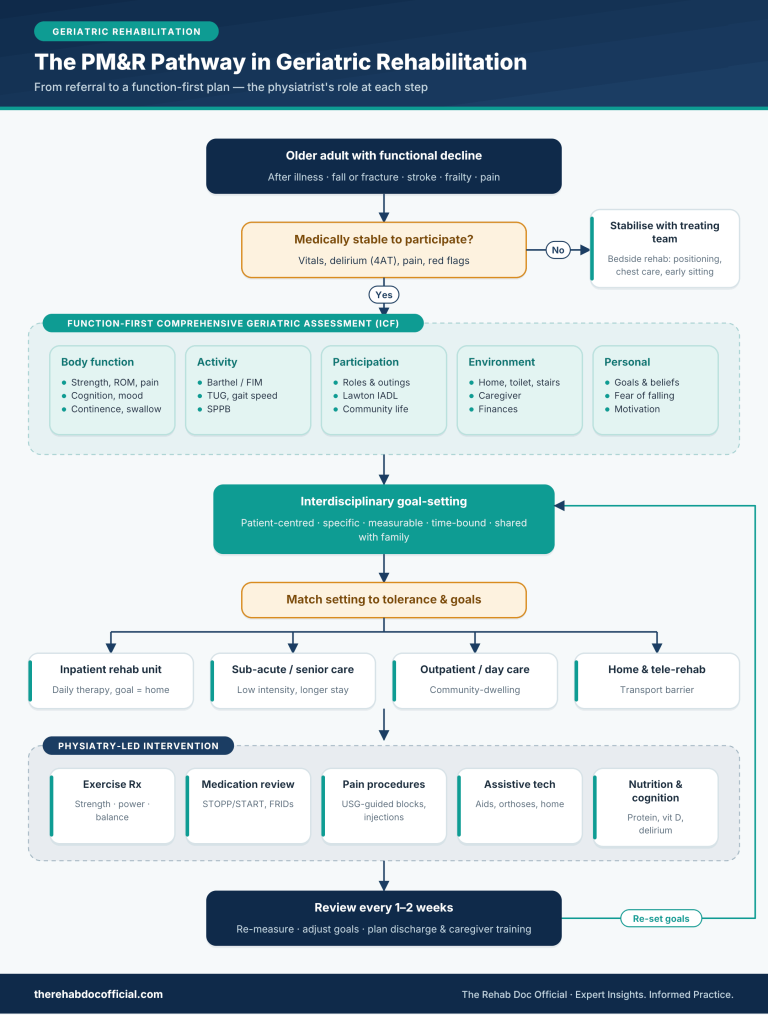
The flowchart below summarises how the PM&R physician moves an older patient from referral to an individualised plan and the right setting.
Goal-setting: the heart of the process

Older patients rarely want to “improve their Barthel score”. They want to attend a wedding, sleep without pain, or not be a burden on their son. Good goals are:

  • Patient-centred— stated in the patient’s own words wherever possible.
  • Specific and measurable— “walk 50 metres with a rollator to the building lift, independently, within 3 weeks”.
  • Realistic— calibrated to prognosis, frailty and comorbidity.
  • Shared— known to every member of the team and the family.

Equally important is the honest conversation when full recovery is not realistic. The physiatrist helps families redefine success — for example, safe wheelchair independence and a caregiver trained in transfers — and plans the support needed for that new baseline.

Common pitfalls the physiatrist can prevent

  1. “Too old for rehab.”Age alone is not a contraindication. Frailty status, cognition and goals predict benefit far better than birth year.
  2. Bed rest “until stronger”.Immobility is the cause of weakness, not the cure. Mobilise early, within medical safety limits.
  3. Ignoring cognition.Undiagnosed dementia or delirium explains many “non-compliant” patients. Screen every patient.
  4. Ignoring nutrition.Exercise without adequate protein and energy cannot build muscle in a malnourished older adult.
  5. Discharging without the home.A patient who walks well in the gym can fail at home because of a single step at the bathroom door.

Key takeaways for clinicians

  • The PM&R physician brings a function-first, ICF-based lens to Comprehensive Geriatric Assessment.
  • Six core roles: functional diagnostician, medication reviewer, exercise prescriber, procedural pain specialist, assistive-technology expert and team leader.
  • Measurable, patient-centred goals and the right care setting are the two decisions that most shape outcomes.
  • With India’s older population set to roughly double by 2050, physiatry-led geriatric rehabilitation is an urgent clinical and public-health need.

Dr. Deepak Prasad J MBBS MD PM&R CCPC FIPM

As the Consultant and Incharge of the NeuroRehabilitation and Musculoskeletal & Sports Rehab Units at Kauvery hospitals Bangalore & Hosur, I lead and empower a diverse team of specialists—including physiotherapists, occupational therapists, speech & swallow therapists, and clinical psychologists, Rehabilitation Nurses—to provide patient-centered care and achieve outstanding results.

Leave a Reply

Your email address will not be published. Required fields are marked *

Scroll to Top