The Rehab Doc Offical

TOI Style Scroll Menu

Falls in Older Adults: The Physiatrist's Approach to Risk Stratification, Assessment and Prevention

A fall is never "just a fall"

Roughly one in three adults over 65 falls each year, and the proportion rises with age and frailty. Falls are a leading cause of injury-related disability and death in older people, and many of the patients who arrive on a PM&R service with a hip fracture, a subdural haematoma or a vertebral compression fracture began their journey with a fall at home.

Even falls without injury carry consequences. Fear of falling leads to self-imposed activity restriction, which leads to deconditioning and weakness, which leads to more falls — a downward spiral that is entirely familiar to anyone who works in geriatric rehabilitation.

A fall is best understood as a symptom: the visible end-point of several interacting problems in gait, balance, strength, vision, cognition, cardiovascular regulation, medication and environment. Because every one of those components is something the physiatrist assesses routinely, PM&R is ideally placed to lead falls assessment and prevention.

The framework: World Falls Guidelines 2022

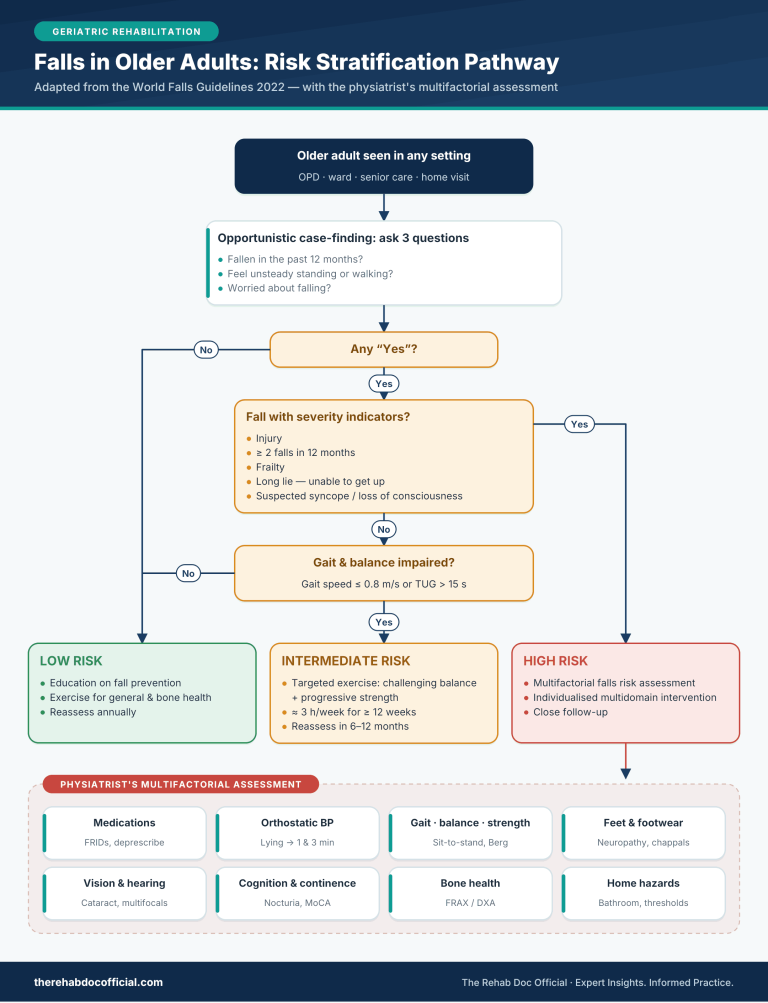
The World Guidelines for Falls Prevention and Management for Older Adults (Montero-Odasso et al., Age and Ageing, 2022) provide a practical, globally applicable structure. They recommend opportunistic case-finding — asking about falls whenever an older adult has contact with a health professional — followed by risk stratification into low, intermediate and high risk.

Step 1: Ask three simple questions

  • Have you fallen in the past 12 months?
  • Do you feel unsteady when standing or walking?
  • Are you worried about falling?

A “yes” to any of these warrants further evaluation.
Step 2: Check for fall severity

The patient is at high risk if a fall was accompanied by any of the following:
  • An injury
  • Two or more falls in the past 12 months
  • Frailty
  • Lying on the floor and being unable to get up
  • Suspected syncope or loss of consciousness

Step 3: Assess gait and balance

If there are no severity indicators, a quick objective measure separates intermediate from low risk:
  • Gait speed ≤ 0.8 m/s, or
  • Timed Up and Go (TUG) > 15 seconds
Impaired gait or balance indicates intermediate risk; normal performance indicates low risk. The flowchart below summarises this stratification and the corresponding interventions.

Matching intervention to risk

Risk Level
Recommended Response
Low
Education on fall prevention; encourage regular exercise for general health and bone health; reassess annually
Intermediate
Targeted exercise programme emphasising balance and strength; reassess in 6–12 months
High
Multifactorial falls risk assessment followed by individualised, multidomain intervention; close follow-up

The multifactorial assessment for high-risk patients is where the physiatrist’s training is most valuable.

The physiatrist's multifactorial falls assessment

History of the fall

Establish the circumstances: time of day, activity, footwear, lighting, whether there was a prodrome (dizziness, palpitations, vertigo), whether the patient tripped or the legs “gave way”, and how long they remained on the floor. A fall on getting up at night to urinate points to a different set of causes than a fall while crossing a busy road.

Medication review

Fall-risk-increasing drugs (FRIDs) are among the most modifiable risk factors. Look specifically for:

  • Benzodiazepines and Z-drugs
  • Antidepressants and antipsychotics
  • Sedating antihistamines and anticholinergics (including many bladder medications)
  • Antihypertensives, alpha-blockers and diuretics causing orthostatic hypotension
  • Opioids and gabapentinoids
  • Hypoglycaemic agents in patients with tight glycaemic targets

Deprescribing should be planned with the patient’s treating physician and tapered where appropriate.

Physical examination — the physiatrist's domain

  • Orthostatic blood pressure (lying and after 1 and 3 minutes standing)
  • Gait analysis: base of support, step length, cadence, arm swing, turning, use of furniture for support
  • Balance: Romberg, tandem stance, single-leg stance, Berg Balance Scale where time permits
  • Lower-limb strength: hip abductors, hip extensors, quadriceps and ankle dorsiflexors; five-times sit-to-stand
  • Sensation and proprioception: peripheral neuropathy is very common in Indian older adults with long-standing diabetes
  • Feet and footwear: deformities, pain, ill-fitting chappals and slippers
  • Musculoskeletal pain: knee osteoarthritis and lumbar canal stenosis frequently alter gait
  • Neurological signs: parkinsonism, cerebellar signs, residual hemiparesis, cervical myelopathy

Cognition, mood and continence

Screen for cognitive impairment (Mini-Cog or MoCA) and depression. Urinary urgency and nocturia drive night-time trips to the toilet — a classic fall scenario.

Vision and hearing

Cataract, uncorrected refractive error and the use of multifocal glasses while walking all increase fall risk. Cataract surgery for the first eye has been shown to reduce falls.

Bone health

Every faller should have fracture risk assessed. Use FRAX where applicable and arrange DXA where it will change management. A fall in an osteoporotic patient is a fracture waiting to happen.

The environment

Indian homes present specific hazards: wet bathroom floors, Indian-style toilets requiring a deep squat, raised door thresholds, loose rugs and floor mats, poor lighting on stairways, and floor-level seating and sleeping. Where a home visit is not feasible, photographs or a video call taken by a family member are a practical substitute.

Exercise: the cornerstone intervention

Exercise is the single most effective falls prevention intervention for community-dwelling older adults. The Cochrane review by Sherrington et al. (2019) found that:
  • Balance and functional exercises reduce the rate of falls by about 24%.
  • Programmes combining multiple exercise types(typically balance plus resistance training) reduce the rate of falls by about 34%.
  • Tai Chi reduces the rate of falls by about 19%.
The physiatrist’s role is to convert this evidence into a precise prescription:
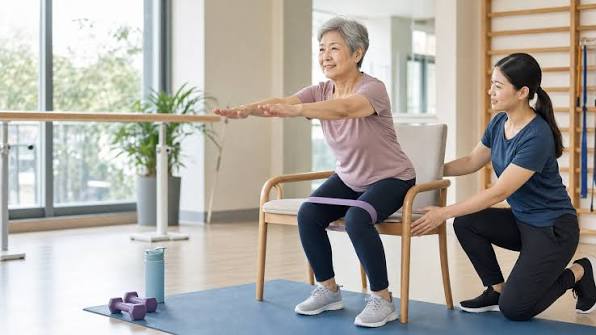
  • Balance that genuinely challenges the patient — narrowing the base of support, reducing hand support, shifting weight, stepping and turning. Balance exercise that is not challenging does not work.
  • Progressive resistance training for the hip and knee extensors, hip abductors and ankle muscles.
  • Functional training: sit-to-stand, stepping, getting up from the floor (a critical, often neglected skill).
  • Dose: the greatest benefits are seen with programmes delivering roughly 3 hours per week, continued for at least 12 weeks, and ideally ongoing. Supervised sessions can be combined with a structured home programme.
  • Safety: start supervised, progress gradually, and adapt for cardiac disease, severe osteoarthritis and cognitive impairment.
Yoga-based balance programmes, when appropriately modified, are culturally familiar and can improve adherence among Indian older adults.  

Assistive devices, orthoses and protective strategies

  • Walking aids: the correct device, correctly sized and correctly used. A walking stick held in the wrong hand or set at the wrong height can increase risk.
  • Footwear: closed-heel, firm-soled, well-fitting footwear rather than loose slippers.
  • Ankle-foot orthosesfor foot drop after stroke or neuropathy.
  • Hip protectorsfor selected high-risk patients in care facilities.
  • Home modifications: grab rails in bathroom and toilet, a commode chair or raised toilet seat, non-slip mats, night lights, and removal of trip hazards.
  • Alarm and alert systems: pendant alarms or a mobile phone carried at all times for those living alone.
  • Floor recovery training: teaching patients and caregivers how to get up safely after a fall reduces the complications of a long lie.

Managing fear of falling

Fear of falling is common, disabling and treatable. It can be measured with the Falls Efficacy Scale–International (FES-I). Graded exposure through exercise, education, and — where appropriate — cognitive-behavioural strategies help restore confidence. The physiatrist should explicitly address fear as part of the rehabilitation goals rather than treating it as a side issue.

Key takeaways for clinicians

  • Ask every older patient three questions about falls, unsteadiness and worry about falling.
  • Stratify risk using fall severity, gait speed (≤ 0.8 m/s) and TUG (> 15 s).
  • High-risk patients need a multifactorial assessment— the physiatrist’s strength — covering medications, gait, balance, strength, cognition, vision, bone health and environment.
  • Challenging balance plus resistance training, delivered at an adequate dose, is the most effective preventive intervention.
  • Every faller deserves a bone health assessment.

Dr. Deepak Prasad J MBBS MD PM&R CCPC FIPM

As the Consultant and Incharge of the NeuroRehabilitation and Musculoskeletal & Sports Rehab Units at Kauvery hospitals Bangalore & Hosur, I lead and empower a diverse team of specialists—including physiotherapists, occupational therapists, speech & swallow therapists, and clinical psychologists, Rehabilitation Nurses—to provide patient-centered care and achieve outstanding results.
Leave a Reply

Your email address will not be published. Required fields are marked *

Scroll to Top