Early Mobilisation After Stroke: Timing, Dose and the Stroke-Unit Care Bundle
Why when and how much you mobilise a patient matters as much as whether you do
“Get them moving early” is now reflexive advice in stroke care — but the evidence is more nuanced than a blanket rule. The AVERT trial revealed that very early, high-dose mobilisation can actually worsen outcomes, while a well-timed, appropriately dosed programme delivered within an organised stroke unit remains one of the highest-value interventions in acute stroke rehabilitation. This article separates the timing question from the dose question and places both within the broader stroke-unit care bundle.
The Core Tension: Move Early, But Not Too Early
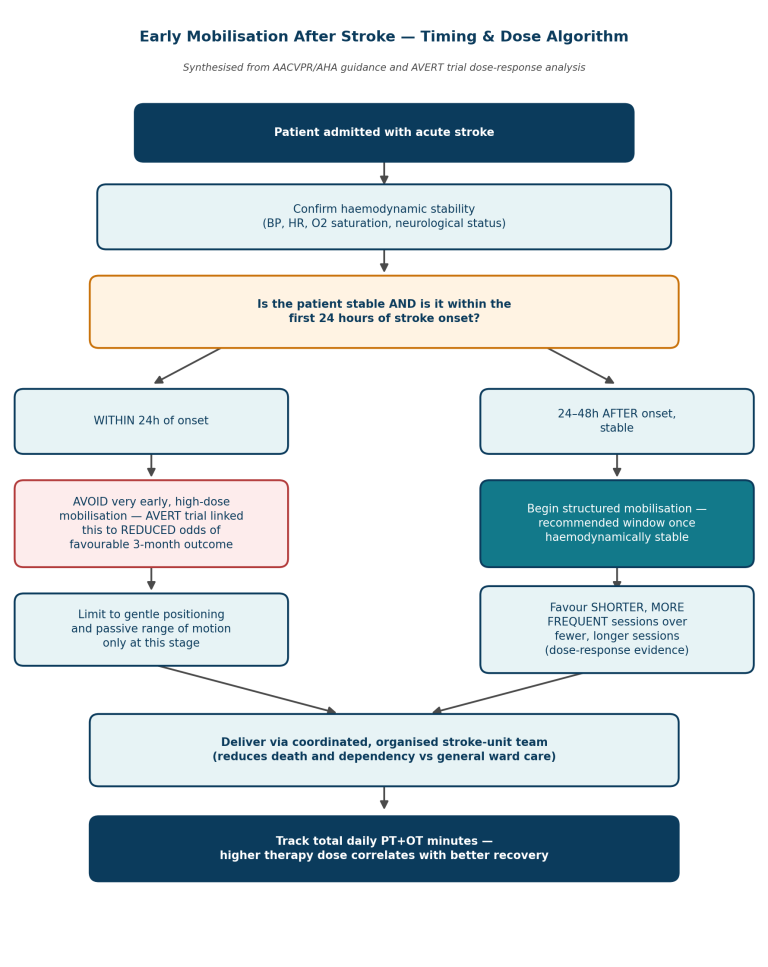
Early, structured mobilisation within 24–48 hours of stroke onset is recommended once the patient is haemodynamically stable — this remains a cornerstone AHA/ASA guideline recommendation. Intuitively, this suggests earlier is always better. The AVERT trial complicated that assumption directly: very early (under 24 hours), high-dose mobilisation was associated with reduced odds of a favourable 3-month outcome compared with usual care. The trial did not discredit early mobilisation as a concept — it discredited a specific pattern of very-early, high-intensity dosing.
A subsequent dose-response analysis of the AVERT data clarified the picture further: shorter, more frequent mobilisation sessions may be more favourable than fewer, longer sessions. In other words, the total minutes of therapy matter less than how those minutes are distributed across the day.
Rehab Pearl
Very early (<24h), high-dose mobilisation was associated with reduced odds of favourable 3-month outcome after stroke — timing and dose both matter (AVERT Trial Collaboration group, Lancet. 2015;386(9988):46–55).
A Working Timing & Dose Algorithm
The following algorithm translates the AVERT findings and AHA/ASA guidance into a bedside decision pathway — confirming stability first, respecting the 24-hour threshold, and favouring frequent, shorter sessions over infrequent, longer ones once mobilisation begins.
Mobilisation Doesn't Happen in Isolation: The Stroke-Unit Bundle
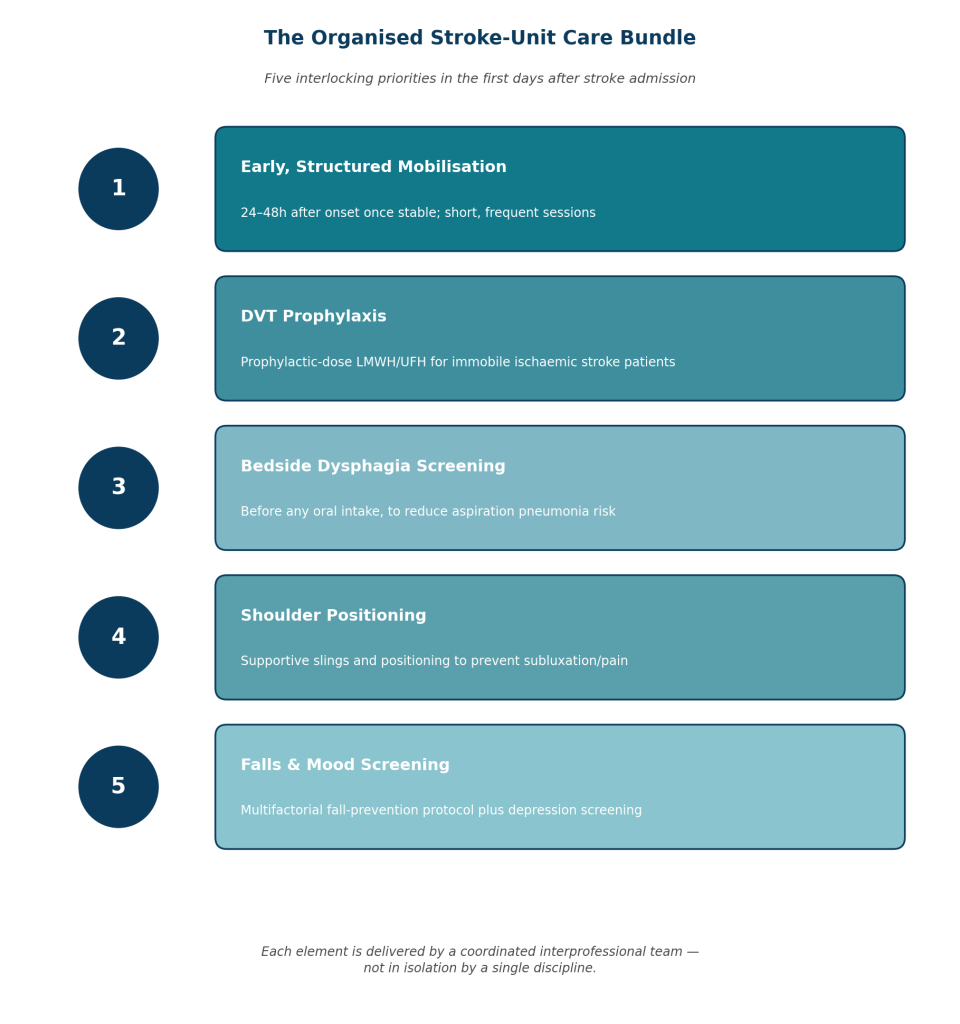
Organised stroke-unit care by a coordinated interprofessional team reduces death and dependency compared with general ward care. Mobilisation is one thread in a bundle of concurrent priorities that must be delivered together, not sequentially, for this benefit to materialise. The figure below summarises the five elements that most consistently appear across stroke-unit protocols.
Why Each Element Matters
Prophylactic-dose LMWH or UFH is recommended for DVT prevention in immobile ischaemic stroke patients during rehab admission — a risk that mobilisation itself reduces but does not eliminate in the early window. Bedside dysphagia screening before any oral intake reduces aspiration pneumonia risk, and should be completed before the first meal or medication is given by mouth, independent of the mobilisation plan. Hemiplegic shoulder subluxation and pain is a common early complication; positioning and supportive slings are first-line prevention and should be initiated from the same first assessment that triggers the mobilisation order.
Falls are a leading inpatient rehabilitation complication after stroke, and structured, multifactorial fall-prevention protocols reduce incidence — a particularly relevant safeguard as mobilisation intensity increases. Systematic screening and early treatment of post-stroke depression is likewise associated with better functional recovery, reinforcing that psychological status should be assessed alongside physical readiness rather than deferred to a later stage of the admission.
Tracking Therapy Dose, Not Just Milestones
Higher total therapy time (physiotherapy plus occupational therapy minutes per day) in the early post-stroke weeks correlates with better functional recovery. In practice, this means the rehabilitation team should track cumulative daily therapy minutes as a monitored metric — much as vital signs are tracked — rather than relying solely on qualitative milestones such as “sat at edge of bed” or “stood with assistance.” A patient who reaches the same milestones but receives less cumulative therapy time is, on the current evidence, likely to have a less favourable trajectory.
Practical Takeaway for the Ward
For a haemodynamically stable patient at hour 30 post-onset, the recommended approach is to begin mobilisation now, but in short bouts — for example, three or four 10–15 minute sessions distributed across the day — rather than one long 45–60 minute session. This respects both the AVERT timing caution and the dose-response findings, while allowing the DVT, dysphagia, shoulder, falls and mood elements of the bundle to be assessed and initiated within the same admission window.
Key Takeaways
- Early mobilisation (24–48h) is recommended once stable — but very early (<24h), high-dose mobilisation is associated with worse outcomes.
- Favour shorter, more frequent sessions over fewer, longer ones once mobilisation begins.
- Mobilisation is one of five concurrent stroke-unit bundle priorities: DVT prophylaxis, dysphagia screening, shoulder positioning, and falls/mood screening.
- Track cumulative daily PT+OT minutes as an active metric, not just movement milestones.
- Delivery through a coordinated interprofessional stroke-unit team is itself an evidence-based intervention, independent of any single component.