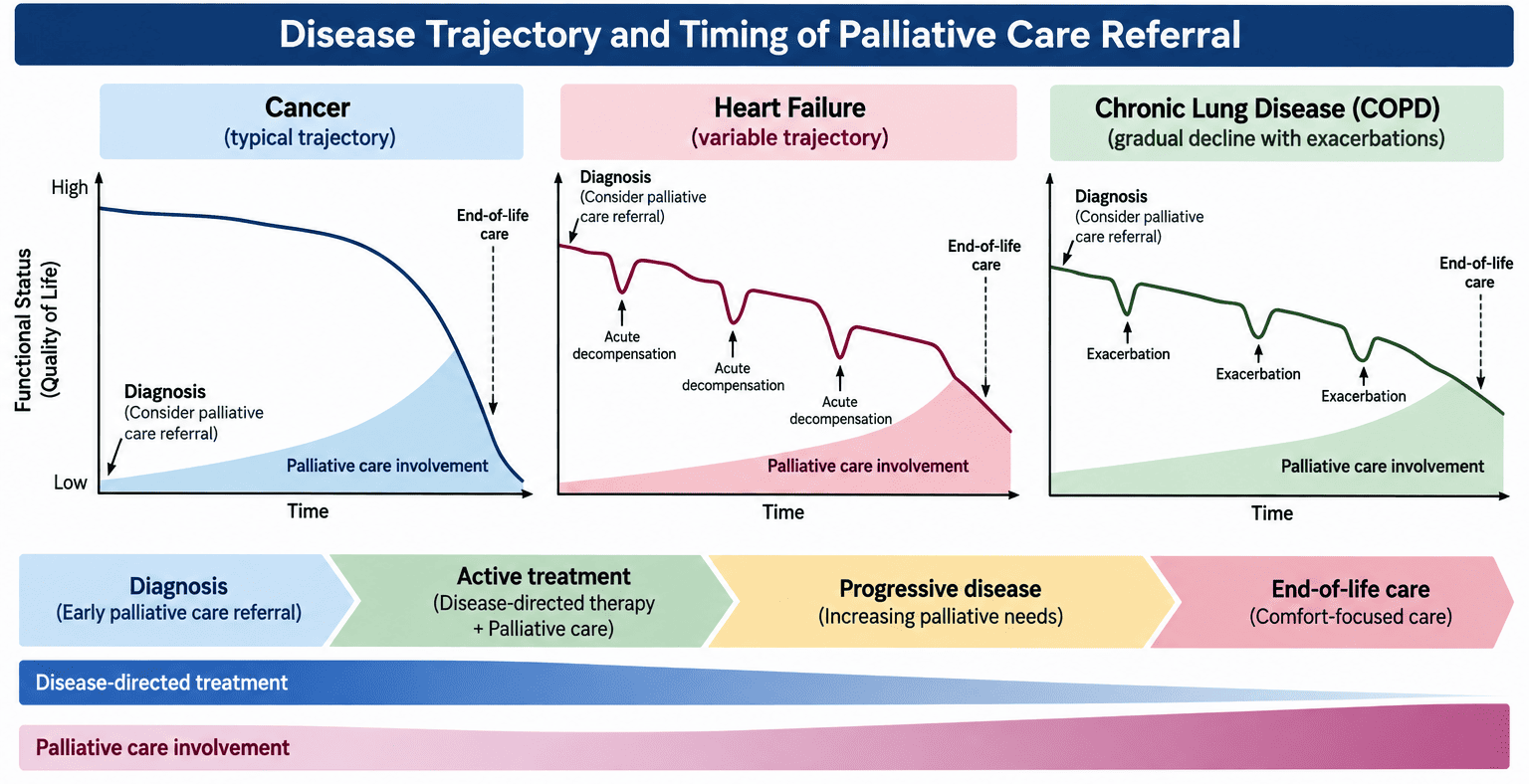
Breaking bad news is one of the most challenging and emotionally demanding responsibilities in healthcare. Bad news refers to any information that significantly and negatively alters a patient’s or family’s expectations about the present or future, such as a diagnosis of cancer, disease progression, treatment failure, transition to palliative care, or a poor prognosis. The way this information is communicated can profoundly influence patients’ emotional well-being, trust in healthcare professionals, treatment decisions, and long-term coping.
Effective communication of bad news requires more than clinical knowledge; it demands empathy, honesty, cultural sensitivity, and excellent interpersonal skills. Poorly delivered bad news may lead to confusion, anxiety, loss of trust, psychological distress, and dissatisfaction with care, whereas compassionate communication can strengthen the therapeutic relationship, facilitate shared decision-making, and improve patient and family outcomes.
The SPIKES protocol, first described by Baile and colleagues in 2000, is one of the most widely accepted evidence-based frameworks for delivering bad news. It provides a structured six-step approach that helps healthcare professionals prepare for the conversation, understand the patient’s perspective, share information appropriately, respond empathetically to emotions, and collaboratively plan the next steps. Although initially developed in oncology, the SPIKES protocol is now widely applied across palliative care, intensive care, emergency medicine, nephrology, neurology, and many other specialties.
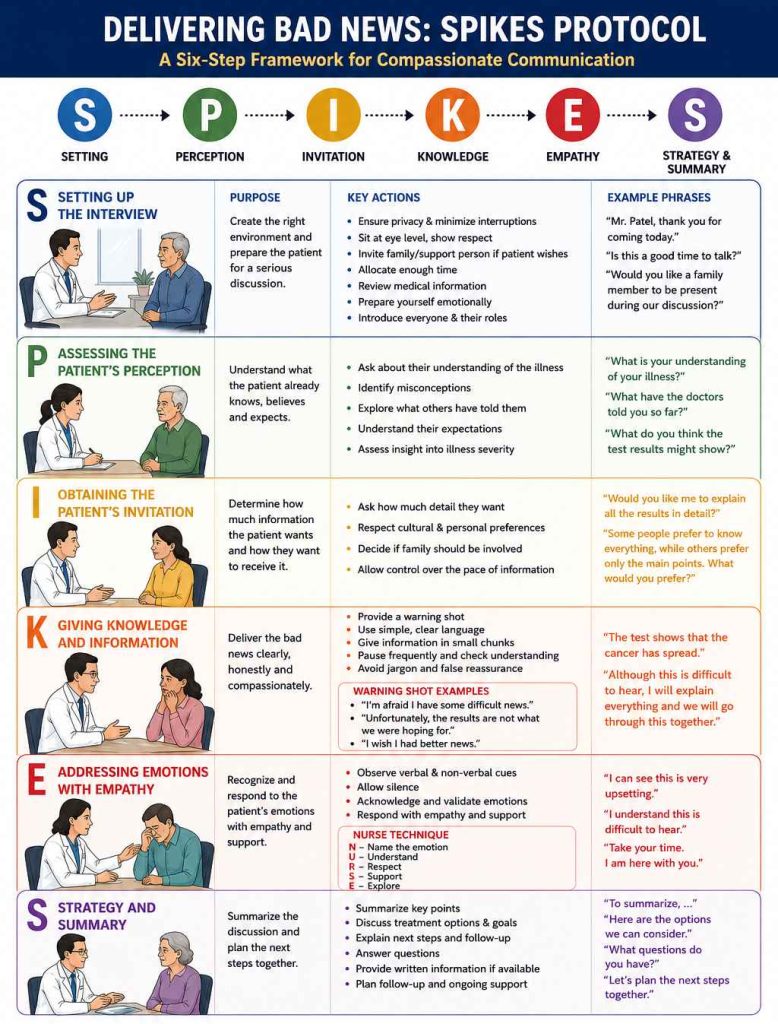
The SPIKES protocol is a structured, evidence-based communication model designed to help healthcare professionals deliver bad news with empathy, clarity, and professionalism. Developed by Baile et al. in 2000, the protocol provides a stepwise approach that ensures important aspects of communication are not overlooked during emotionally challenging conversations. Rather than serving as a rigid script, SPIKES acts as a flexible framework that can be adapted to individual patients, cultural contexts, and clinical situations. By following these six sequential steps, clinicians can improve patient understanding, respond appropriately to emotional reactions, and facilitate shared decision-making.
🟦S – Setting the interview
🟩P – Perception of patient or relatives
🟨I – Invitation in discussion
🟧K – Knowledge
🟥E – Empathy
🟪S – Strategy & Summary
The first step of the SPIKES protocol focuses on creating an environment that facilitates open, honest, and compassionate communication. A well-prepared setting demonstrates respect for the patient, minimizes distractions, and allows adequate time for discussion. The manner in which bad news is delivered often influences the patient’s emotional response as much as the information itself.
“Mr. Patel, thank you for coming today. Is this a good time to talk? Would you like a family member to be present during our discussion?”
Before providing new information, clinicians should determine what the patient already understands about their illness. Patients often have varying levels of knowledge, misconceptions, or denial. Understanding their perception allows the clinician to tailor the conversation appropriately and avoid overwhelming the patient.
Not every patient wishes to receive the same amount of medical information. Some prefer complete disclosure, while others want only essential details or prefer information to be shared with family members. This step respects patient autonomy and individual preferences.
This is the step in which the clinician communicates the bad news. Information should be delivered honestly, clearly, and compassionately while avoiding excessive medical jargon. The discussion should proceed gradually, allowing the patient time to process the information.
Examples include:
Patients may respond with shock, sadness, anger, fear, denial, or silence after receiving bad news. This step emphasizes recognizing these emotions and responding with empathy rather than immediately providing more medical information.
Empathy:
After the patient has had time to process the information, the conversation should conclude with a clear summary and an agreed-upon management plan. This restores a sense of direction and helps patients feel supported despite difficult news.
“Although we cannot cure the cancer, we have several treatments that can help control your symptoms and maintain your quality of life. We will continue to support you and your family throughout this journey.”
Delivering bad news is a fundamental clinical skill that requires empathy, honesty, and effective communication. The SPIKES protocol provides a structured, patient-centered framework that helps healthcare professionals prepare for difficult conversations, understand patients’ perspectives, communicate information clearly, respond compassionately to emotions, and develop a shared plan for ongoing care. By combining clinical expertise with empathy and respect, clinicians can reduce distress, strengthen the therapeutic relationship, and support patients and families through challenging moments. Ultimately, breaking bad news is not just about conveying difficult information—it is about ensuring that no patient or family faces that news without compassion, dignity, and continued support.
|
DO'S
|
DONT'S
|
|---|---|
|
Prepare before the conversation.
|
Deliver bad news without preparation.
|
|
Choose a private, quiet setting.
|
Discuss in public or busy areas.
|
|
Sit at eye level with the patient.
|
Stand over the patient or rush the discussion.
|
|
Introduce yourself and everyone present.
|
Assume the patient knows who everyone is.
|
|
Assess the patient’s understanding first.
|
Make assumptions about what the patient knows.
|
|
Ask how much information the patient wants
|
Force unwanted details on the patient.
|
|
Use simple, clear language.
|
Use complex medical jargon.
|
|
Give a “warning shot” before the news.
|
Deliver the diagnosis abruptly.
|
|
Speak honestly and compassionately.
|
Give false reassurance or misleading information.
|
|
Pause frequently and allow silence.
|
Talk continuously without checking understanding.
|
|
Acknowledge and validate emotions.
|
Ignore, interrupt, or dismiss emotional reactions.
|
|
Listen actively and answer questions.
|
Dominate the conversation or argue with emotions.
|
|
Maintain realistic hope by discussing available support and treatment options.
|
Say, “There’s nothing more we can do.”
|
|
Summarize the discussion and outline next steps.
|
End the conversation immediately after giving the news.
|
|
Arrange follow-up and ongoing support.
|
Leave the patient without a clear plan.
|


I am a physician specialized in Palliative Medicine (MD) with a strong commitment to improving the quality of life for patients with life-limiting illnesses. My clinical focus is on comprehensive symptom management, holistic patient care, and psychosocial support for patients and families.Beyond clinical practice, I am deeply interested in palliative care education, research, and integrating evidence-based practices into patient-centered care. I aim to contribute to the growth of palliative care services, raise awareness about end-of-life issues, and advocate for a more compassionate healthcare system.