Increased muscle tone is one of the most common referral triggers in post-stroke rehabilitation, yet it is frequently mismanaged — either over-treated with escalating chemodenervation in limbs that would respond to positioning and stretching, or under-treated in limbs where a fixed contracture has silently taken hold. This article consolidates the current evidence base into a single working framework: how to grade tone, how to decide between conservative, pharmacological and procedural options, and how to sequence therapies so that function — not the tone score itself — remains the outcome that matters.
Spasticity is a velocity-dependent increase in muscle tone resulting from upper motor neuron injury. After a stroke affecting the corticospinal tract, the loss of descending inhibitory control allows spinal reflex arcs to become hyperexcitable. Clinically, this manifests within days to weeks as resistance to passive stretch, exaggerated tendon reflexes, and clonus in affected limbs — most classically the flexed elbow/wrist/fingers and the plantarflexed, inverted ankle.
Left unaddressed, dynamic spasticity can evolve into fixed contracture as shortened muscle fibres and periarticular connective tissue undergo structural change. This distinction — dynamic versus fixed — is the single most important branch point in management, because the two states call for fundamentally different first-line treatments.
Brunnstrom’s sequential stages remain a practical framework for describing and pacing motor recovery post-stroke, moving from flaccidity through the emergence of spasticity and synergy patterns to relative normalisation of tone and isolated movement. Overlaying a patient’s Brunnstrom stage onto the tone-management plan helps set realistic, stage-appropriate expectations for both patient and family.
For spasticity itself, the Modified Ashworth Scale (MAS) is the standard bedside grading tool, valued for its simplicity and good interrater reliability. The examiner passively moves the joint through its range and grades resistance from 0 (no increase in tone) to 4 (limb rigid in flexion or extension). MAS should be paired with a passive range-of-motion assessment at every visit — a joint that is losing passive range despite unchanged MAS grade is the earliest clinical signal of evolving contracture.
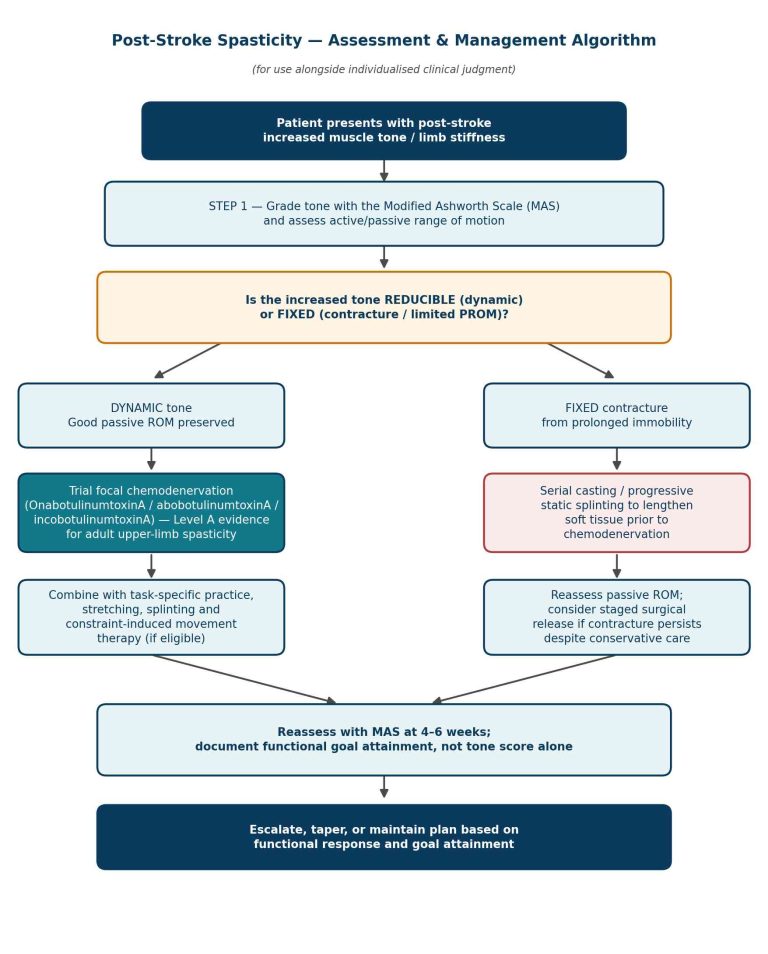
Once tone is graded, the central clinical question is whether it is reducible (dynamic) or fixed (a true contracture with restricted passive range). The algorithm below structures this decision and the pathways that follow from it.
Spasticity management is best conceptualised as a ladder rather than a single decision. Every patient starts on the foundational rungs; escalation to injectable or surgical rungs is reserved for those who fail to make functional gains at defined reassessment intervals — not for those with a high tone score in isolation.
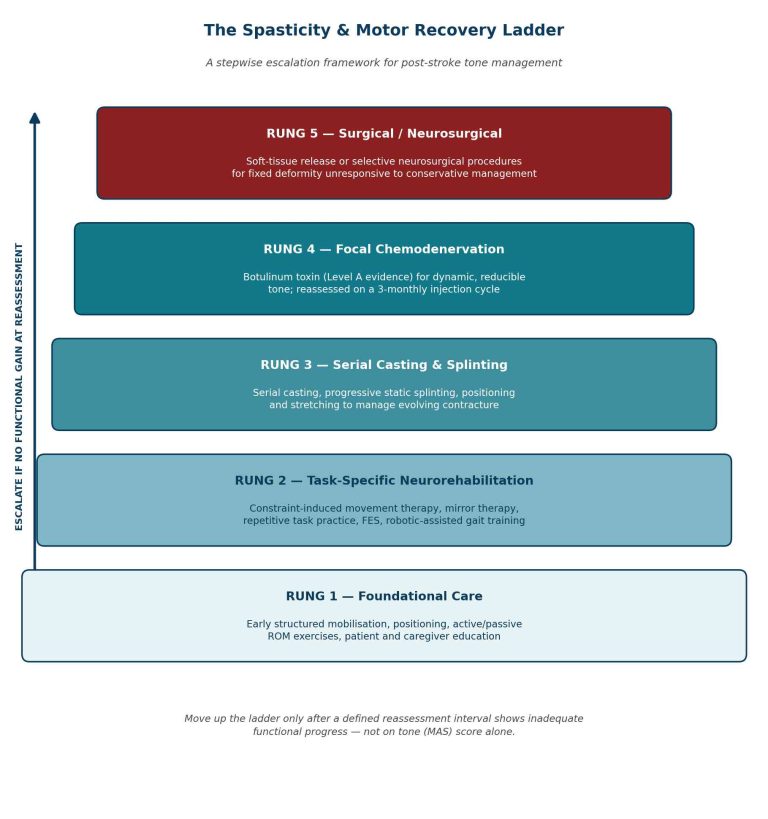
Early, structured mobilisation and positioning form the base of every plan. Layered on this, task-specific, high-repetition practice is the behavioural driver of use-dependent cortical reorganisation after stroke — meaning therapy dose and specificity matter as much as any pharmacological intervention. For selected patients with mild-to-moderate hemiparesis and some active wrist and finger extension, constraint-induced movement therapy has been shown to improve upper-limb function. Mirror therapy is a further low-cost adjunct that can improve motor function and reduce pain in the paretic upper limb.
A patient six weeks post-ischaemic stroke presents with a flexed, adducted shoulder and clenched fist, MAS 2 at the elbow and wrist, with full passive range preserved. This is dynamic tone with good rehabilitation potential: the appropriate first move is task-specific practice and stretching, with botulinum toxin considered if functional goals (e.g., donning a sleeve, palm hygiene) are not met within the following reassessment window — not surgery, and not a default injection before conservative options have been trialled.
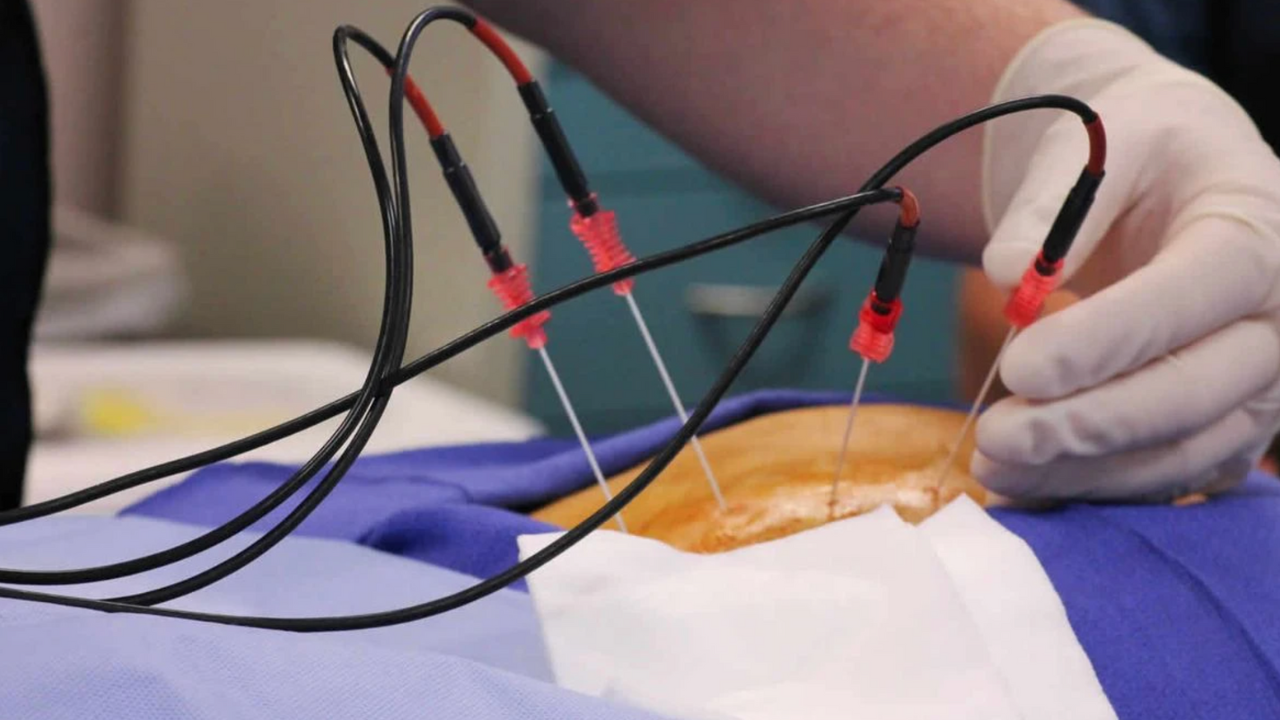
Contrast this with a patient presenting at four months with the same posture but only 30° of passive elbow extension available. The clinical picture here is no longer spasticity alone — a fixed myotendinous contracture has developed, and the mechanical restriction must be addressed alongside the neural component. Chemodenervation is not deferred in favor of casting; rather, BoNT-A is administered concurrently with, or just prior to, the initiation of serial casting. Reducing spasticity first makes the muscle more tolerant of progressive stretch, lowers resistance during cast application, and reduces the risk of skin breakdown or pressure injury from casting against a hypertonic muscle. Serial casting then addresses the fixed shortening that toxin alone cannot correct. Function is restored only when both contributors — the neural drive and the structural contracture — are managed together, not sequentially.

As the Consultant and Incharge of the NeuroRehabilitation and Musculoskeletal & Sports Rehab Units at Kauvery hospitals Bangalore & Hosur, I lead and empower a diverse team of specialists—including physiotherapists, occupational therapists, speech & swallow therapists, and clinical psychologists, Rehabilitation Nurses—to provide patient-centered care and achieve outstanding results.